
Curious about Romanesque art? Step insideFleury Abbey. We were struck by the simplicity of its basilica, which has watched over the relics of Saint Benedict for nearly 1,400 years. With its porch tower featuring carved capitals, 11th-century crypt, and a view of the apse from the Belvédère, this site—still home to Benedictine monks—is well worth a visit.
In this article, you'll find some useful tips to help you prepare for your visit and have a wonderful time!
This guide is completely independent, based on our experiences. We visited the region anonymously, making our own choices and paying our bills in full.
Why visit Fleury Abbey?
Is Fleury Abbey worth the trip? Our take:
Yes, Fleury Abbey is well worth a visit. The basilica alone offers a comprehensive overview of Romanesque art, from the 11th-century porch tower to the crypt that houses the relics of Saint Benedict. We also enjoyed continuing our exploration at the Belvédère, where the scale models shed light on the site’s history.
It’s one of the most beautiful in the Loire Valley!

Why is Fleury Abbey famous?
The abbey is, above all, the guardian of the relics of Saint Benedict of Nursia, an Italian monk who wrote the rule followed by the Benedictines in the 6th century. Their arrival from Monte Cassino, Italy, brought fame to the monastery, so much so that the village took the name Saint-Benoît-sur-Loire.
In the 10th and 11th centuries, Fleury also became a major intellectual center of the West: its abbot, Abbon, was considered the most learned man of his time. Finally, it is worth noting the tomb of King Philip I, who was buried in the choir in 1108. The abbey is also located in the part of the Loire Valley that has been listed as a UNESCO World Heritage Site since 2000.

Our favorite moments
Here are the three moments that made the biggest impression on us:
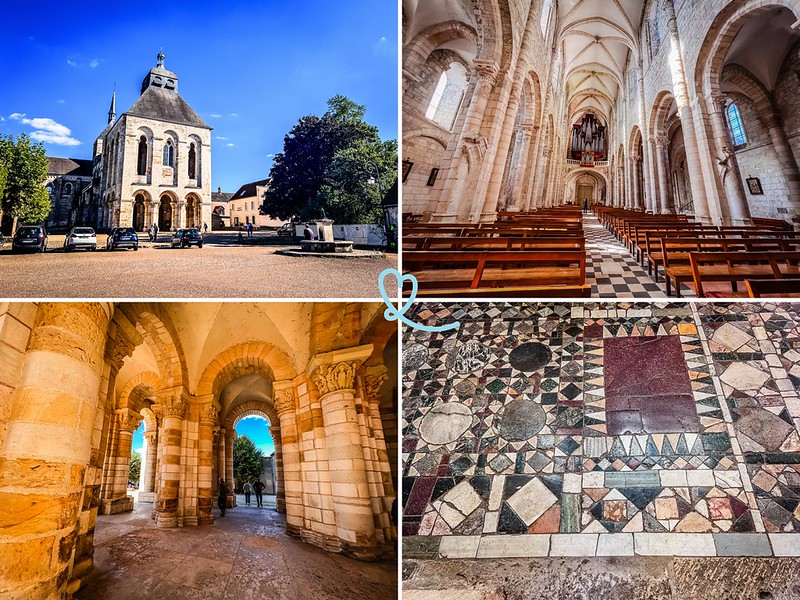
- Describe the carved capitals of the porch tower, where foliage, fantastical creatures, and biblical scenes intertwine.
- The floors—the most surprising ones we've ever seen in an abbey!
- Admire the apse of the Basilica from the third floor of the Belvédère—a panoramic view that’s impossible to get from the street.

WHERE TO STAY IN THE Loire Valley
Our independent picks for the accommodation of your dreams:


Directions and Map: Fleury Abbey, Saint-Benoît-sur-Loire
Where is Fleury Abbey located?
- In the village of Saint-Benoît-sur-Loire, in the Loiret department, at 1 Place de l'Abbaye
- Travel time from Sully-sur-Loire: 10 min
- Travel time from Orléans: 35 min
- Travel time from Blois: 1 hour 15 minutes
- Travel time from Tours: 1 hour and 40 minutes
How to get there?
Several options are available to you:
- By car: This is the easiest option. From the A10 highway, take Exit 14 toward Montargis, then follow the RD 2060 to the Châteauneuf-sur-Loire exit. From the A77, take Exit 18 toward Châteauneuf-sur-Loire, then the RD 2060.
- By train: The nearest stations are Gien (32 km, Nevers–Gien–Paris line), Orléans Centre (38 km), and Les Aubrais (40 km), all of which are connected to Paris.
- By bus: From Orléans, Line 3 of the Rémi regional transit system serves Saint-Benoît-sur-Loire. Get off at the Saint-Benoît-sur-Loire - Planchette stop. The trip takes about 1 hour.
- Cycling: The "La Loire à Vélo" route passes through the port of Saint-Benoît-sur-Loire, 900 meters from the town center. Bike racks are available at the Belvédère.

Parking
The Belvédère offers free parking. From there, a 250-meter pedestrian path runs along the monastery grounds to the Basilica.

OUR TIPS FOR RENTING A CAR IN Loire
- Compare prices on our preferred platform: DiscoverCars - one of the best rated sites.
- Choose a fairly compact car (many villages have narrowed the road).
- Think aboutfull insurance (parking in big cities is really tight).
- There is a lot of demand, book it early.

Helpful Tips: Duration, Hours, Dining...
Best time to visit
The Basilica is open every day of the year, from 6:30 a.m. to 10:00 p.m. Please keep in mind that it is first and foremost a place of worship for parishioners and the monastic community: religious services take priority over visits. We therefore recommend avoiding Sunday mornings, which are reserved for Masses.
Finally, please note that a major restoration project began in late 2023 and will last for five years: scaffolding may obscure certain parts of the building.

Length of visit and main difficulties
Plan on spending half a day to see everything: about 1 hour for the Basilica and 30 minutes to 1 hour for the Belvedere, depending on your interest. The tour presents no major difficulties, aside from the staircase leading down to the crypt. The Belvedere, which spans three levels, is accessible to people with disabilities. Pets are not allowed.

Suggested Route
We recommend the following order:
- Start at the Belvédère to learn about the abbey’s history and the basilica’s architecture through the scale models.
- Go up to the 3rd floor to take in the view of the Basilica and its apse.
- Walk to the Basilica along the 250-meter pedestrian path that runs alongside the monastery grounds.
- Explore the portal tower and its capitals, then the nave and the choir.
- Go down into the crypt, then finish your tour at the north portal and its carved lintel.

Visiting with children
The Belvédère is the best starting point for families. Its bilingual (French-English) tour features interactive activities that blend history, art history, and archaeology, allowing visitors to discover the monks’ way of life or learn about medieval education. During school breaks, workshops are also offered for children, such as the “P'tits mosaïstes” and the “Archi ludique” workshops.
Schedules and rates
The Basilica is open daily from 6:30 a.m. to 10:00 p.m. Admission is free. The monastery and its workshops are not open to the public.
The monastery’s reception desk is open to the public:
- Weekdays: 9:30 a.m. to 11:30 a.m. and 3:00 p.m. to 5:30 p.m.
- Sundays: 9:30 a.m. to 10:30 a.m., 12:30 p.m. to 1:00 p.m., and 3:30 p.m. to 5:30 p.m.
- Visit the official website for more info here.
The Belvédère is open:
- April through September: Tuesday through Sunday, 10 a.m. to 1 p.m. and 2:30 p.m. to 6 p.m.
- In February, March, and October: Tuesday through Sunday, 2:00 p.m. to 5:30 p.m.
- In November and December: Tuesday through Saturday, 2:00 PM to 5:30 PM
- Closed on November 1 and 11, December 25, and throughout the month of January
- Admission costs €5 for full-price tickets and €4 for reduced-price tickets (for ages 13–18, students, teachers, people with disabilities, and their companions, among others).
- Admission is free for children under 12.
- Keep your ticket: it entitles you to a reduced rate at the Château de Sully-sur-Loire and other venues.
- Visit the Belvédère’s official website for more information here.

Guided tours
A team of monks and volunteers is available to guide you through the Basilica. Tours generally take place at 3:15 p.m. on Sundays and holidays, and at 2:45 p.m. on Saturdays (for groups of 5 or more, starting March 1). To reserve a guide, please contact the monastery’s reception desk. From November through February, the monks do not lead tours of the Basilica, but self-guided tours are still available.
The Basilica: A Summary of Romanesque Art
The only remaining part of the medieval abbey, the abbey church is the result of three construction phases, spanning from the early 11th century to the late 12th century. We explored it from west to east, from the porch tower to the crypt.

The gatehouse tower and its capitals
The tour begins in front of the gatehouse, construction of which was begun after 1020 by Abbot Gauzlin, who wanted to make it “an example for all of Gaul.” We were struck by the imposing presence of this massive square structure, with its ground floor featuring a series of arches. Look up at its carved capitals: acanthus leaves, fantastical creatures, and biblical scenes follow one after another.

Walking around each pillar allowed us to discover new motifs time and again. On some of the abbey church’s stones, reddish marks also bear witness to the fire of 1026. Since late 2023, the porch tower has been undergoing the first phase of restoration.

Next, step through the threshold of the nave, which was rebuilt beginning in 1160 under Abbot Macaire. We noticed the transition from one style to another: Romanesque on the choir side, it features Gothic arches as it approaches the tower-porch. Its unadorned elevation reflects an ideal of austerity inspired by Cistercian thought, that of the Order of Cîteaux.

The light-colored stone casts a soft glow throughout the entire length of the building. At the transept crossing, we paused to admire the choir stalls, crafted in 1413 for the monks. On your way out, you’ll notice a carved lintel on the north portal depicting the transfer of Saint Benedict’s relics to Fleury (dated to the 12th or early 13th century, depending on the source).

The choir and the tomb of Philip I
Head toward the choir, which was consecrated on March 21, 1108. Its ambulatory with radiating chapels, complemented by oriented chapels, ranks among the most original architectural designs of its time. We were captivated by the floor, composed of stones, marbles, and porphyries arranged in geometric patterns.

That same year, on August 2, 1108, King Philip I of France was buried there to rest alongside the “father of Western monks.” This royal choice struck us as indicative of Fleury’s prestige in the Middle Ages. Take a moment to pause before his tomb, located beneath the sanctuary.

HAVE FUN WITH THESE activities

The Crypt and the Relics of Saint Benedict
Finally, descend into the crypt, the spiritual heart of the abbey. Construction began in 1067 under Abbot Guillaume, who wished to provide a setting worthy of the relics of Saint Benedict, which had been kept in the choir since 1026. Once reserved for the monks, this vast crypt from the late 11th century retains its original layout. The setting, the stones, and the light create a unique atmosphere.

We were impressed by its massive central pillar, which houses the reliquary containing the relics. The atmosphere invites contemplation: you will sometimes see pilgrims praying there. We recommend that you observe silence, as the place remains, above all, a space for devotion.

The Belvédère: The Abbey Told and Seen from Above
Located 250 meters from the Basilica, the Belvédère is the perfect way to round out your visit. We recommend stopping by before or after visiting the abbey church.

An interactive tour across 3 levels
Opened in 2019, the Belvédère is an interactive space dedicated to the abbey’s history and architecture. We loved its contemporary architecture, designed by the firm CplusD, which evokes both the power of the gatehouse tower and the tranquility of a cloister. Inside, the 583 m² exhibition space features four scale models, two large chronological timelines, and numerous multimedia displays.

There, you’ll encounter the great abbots of Fleury, such as Theodulf, Abbon, and Gauzlin, and you’ll learn how to interpret the basilica’s architecture. Thanks to the model of the apse, we’ve finally understood the layout of the crypt and the chapels. The tour is entirely bilingual in French and English.

The view of the Basilica and its apse
The highlight of the tour, the third floor of the Belvédère offers a unique view of the Basilica and its apse, in the heart of the monastery grounds. We took the time to observe the sequence of the radiating chapels, which is hard to appreciate from ground level. Take advantage of the terrace to admire the entire abbey church and spot the elements you discovered in the exhibition.

A Brief History
Nearly 1,400 years of history are etched into the stones of Fleury. Here is a summary of the major milestones:
- 539: In Italy, Benedict of Nursia wrote the rule governing the monks’ lives at Monte Cassino.
- Between 630 and 650: Monks settled on the north bank of the Loire, 30 km upstream from Orléans, around two churches dedicated to Our Lady and Saint Peter. The two communities merged into a single monastery: Saint-Pierre de Fleury (founded around 648 according to the Belvédère, to be verified).
- Around 660 or 672: Abbot Mommole (Mummolus) had the relics of Saint Benedict brought from Monte Cassino. The abbey becomes Saint-Benoît de Fleury (660 according to the abbey, 672 according to the Belvédère; date to be verified).
- 783–818: Theodulf, advisor to Charlemagne, Bishop of Orléans, and abbot of Fleury, turned the monastery into a center of learning.
- 9th century: The Normans set fire to the monastery on several occasions (865, 879, 897).
- Around 930: Odo of Cluny reformed the abbey, which retained its independence and in turn became a model for others.
- 988–1030: Under Abbots Abbon and then Gauzlin, Fleury reached the height of its influence. Gauzlin began construction of the gate tower. A fire ravaged the abbey in 1026.
- 1067–1108: Construction of the crypt and choir, consecrated on March 21, 1108. On August 2, King Philip I was buried beneath the sanctuary.
- Around 1160–1218: Reconstruction of the nave up to the gate tower. The dedication of the completed basilica took place on October 26, 1218 (the Belvédère dates the completion of the nave to 1207; to be verified).
- 1486: The abbey became a commende; its abbot was henceforth appointed by the king.
- 1562: Looting during the Wars of Religion.
- 1627: Richelieu, the commendatory abbot, entrusted the monastery to the Congregation of Saint-Maur.
- 1790–1791: The Revolution disperses the monks. The monastic buildings are used as a stone quarry, but the church is spared and becomes a parish church.
- 1840: At the initiative of Prosper Mérimée, the abbey church is designated a historic monument.
- October 11, 1944: Thirteen monks from the Abbey of La Pierre-qui-Vire reestablish the community.
- 1947: Pope Pius XII elevated the abbey church to the rank of basilica.
- 2019: Inauguration of the Belvédère, dedicated to the history of the abbey.

Frequently Asked Questions
Fleury Abbey or Saint-Benoît-sur-Loire Abbey: What’s the Difference?
They refer to the same place. The abbey takes its name from the hamlet of Fleury, located 1 km away, the ancient “estate of Florius.” After the arrival of the relics of Saint Benedict, it became Saint-Benoît de Fleury, and the village later took the name Saint-Benoît-sur-Loire. As for the church, it is both an abbey church—since the monks celebrate Mass there—and a basilica, a title granted by Pope Pius XII in 1947.
Is the basilica under construction?
Yes. A major restoration project began in late 2023 and is scheduled to take five years, extending from the west portal tower to the east apse. It will take place in four phases: the porch tower, followed by the nave and side aisles, the transepts, and finally the choir and the stained-glass windows. The Basilica will remain open during the work.
What is there to see near Fleury Abbey?
A 5-minute drive away, the Oratory of Germigny-des-Prés was built between 803 and 806 by Theodulf, abbot of Fleury. Just 10 minutes away, the Château de Sully-sur-Loire is the perfect way to round out your day—especially since your Belvédère ticket entitles you to a discounted admission there.

PLAN YOUR TRIP IN
Loire Valley
The castles of the Loire Valley

Other places to explore

Practice