
The Loire Valley is one of France's most beautiful destinations. Listed as a UNESCO World Heritage Site since 2000, it is home to sumptuous châteaux, waterside villages, renowned vineyards and generous gastronomy.
In this guide, we've put together our 22 tips for a successful trip to the Loire Valley: when to go, how to get around, where to eat, what to visit... Everything you need to know before you leave.
This guide is entirely independent, based on our experience and research. We visit the region anonymously and pay all our expenses.
The essentials for a successful trip to the Loire Valley
Tip 1. When to visit the Loire Valley
The Loire Valley can be visited all year round, and each season offers its own distinct atmosphere. Spring (April-June) remains our favorite time of year: vegetation is at its best, castle gardens are in bloom and tourist numbers are still reasonable. We find a good balance between comfort and tranquillity.
Summer (July-August) is high season. The most visited sites, such as Château de Chambord or Château de Chenonceau, can be very crowded. Temperatures sometimes exceed 35°C in July. If you're traveling at this time of year, we recommend arriving at the sites early and booking your tickets in advance. Autumn offers beautiful light over the vineyards and forests, with far fewer people. Finally,winter is calm and mild. Although many sites are closing their doors, most of the major castles remain open, with cheaper accommodation and a completely different atmosphere.

WHERE TO STAY IN THE Loire Valley
Our independent picks for the accommodation of your dreams:


Tip 2. How long will it take to visit the Loire Valley?
The region is vast and the sites numerous. With 3 days, you can see the essentials: two or three castles, a town and a walk along the river. With one week, you'll be able to explore several areas at once, combining castles, villages, vineyards and gastronomy. To really immerse yourself in the region, we recommend 2 to 3 weeks. It all depends on your pace and interests.
To find out more, see our article on how many days to plan for the Loire Valley.
To get an even better idea of what you can see, here are our itinerary suggestions:

Tip 3 - Where to stay in the Loire Valley
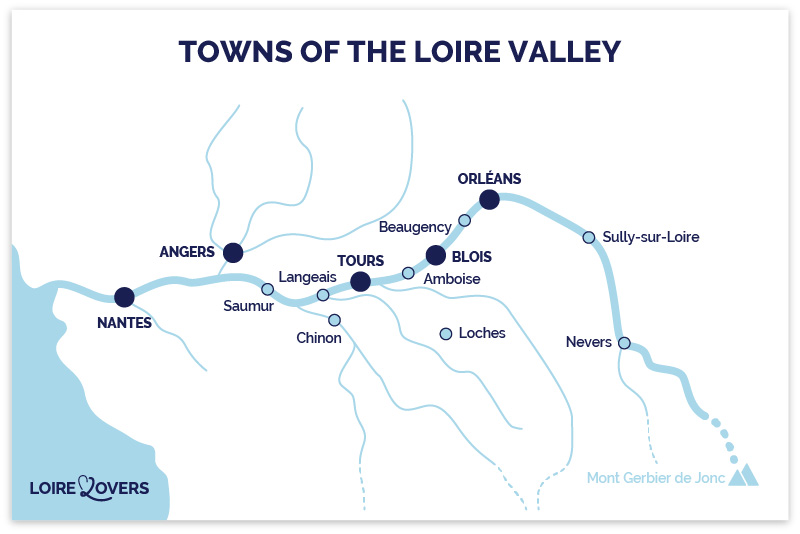
The Loire Valley stretches some 300km from Nantes to Sancerre. It's useful to distinguish three zones when planning your stay. To thewest, Angers and Saumur offer access to medieval castles and troglodyte sites. In the center, Tours, Amboise and Blois form the historic heart of the region, with the highest concentration of Renaissance châteaux. To theeast, Orléans and Sancerre seduce with their architecture and vineyards. Depending on the length of your stay, we recommend concentrating on one or two areas rather than traversing the entire region. Read our article on the most beautiful towns in the Loire.
When it comes to accommodation, the region offers everything from self-catering cottages to charming hotels. One of the most memorable experiences is sleeping in a château: Château du Rivau, Château de Chissay or Château de Ternay offer rooms in exceptional surroundings. We've tried out several of these addresses and recommend them for special stays.
Here are our favorite cities to stay, depending on your area of exploration:
- Amboise: ideally located between Tours and Blois, close to the most visited castles. A pleasant town on a human scale, on the banks of the river. Here is our selection of hotels in the city.
- Saumur: traditional town under the protection of its castle, starting point for troglodytic sites and the vineyards of Anjou. Here is our selection of hotels in the town.
- Tours: the region's most central city, well served by the TGV, with a beautiful old town and pleasant banks of the Loire. Here is our selection of hotels in the city.
- Angers: between the Loire and Maine rivers, with a remarkable heritage and a gentle way of life. Here is our selection of hotels in the city.
- Blois: at the heart of the region, with its castle right in the center of town and quick access to Chambord and Cheverny. Here is our selection of hotels in the city.
- Orléans: the eastern gateway to the valley, remarkable architecture and a more urban atmosphere. Here is our selection of hotels in the city.
See our complete guide to where to stay in the Loire Valley!

OUR TIPS FOR RENTING A CAR IN Loire
- Compare prices on our preferred platform: DiscoverCars - one of the best rated sites.
- Choose a fairly compact car (many villages have narrowed the road).
- Think aboutfull insurance (parking in big cities is really tight).
- There is a lot of demand, book it early.

Tip 4. How to get to the Loire Valley
There are several options for reaching the region, depending on your point of departure and your preferences.
The train is the fastest solution from Paris. From Gare Montparnasse, the TGV takes you to Tours in around 1h and Angers in 1h30. From Gare d'Austerlitz, Intercités trains connect Orléans in 1h and Blois in 1h15. We recommend booking at least 3 weeks in advance for weekends and French school vacations. → Compare timetables and book your train
The car remains the most practical way to explore the region in depth. From Paris, allow around 2h30 for Tours via the A10, 3h for Angers via the A11 and 1h30 for Orléans. → Compare car rental deals

Excursions and transfers organized from Paris are ideal for groups or travelers who want to go directly to the sites without having to deal with travel arrangements. Some packages include a day visit to Chambord, Chenonceau or Villandry. → See excursions from Paris
Flying is relevant for international travelers. Tours Val de Loire Airport serves the heart of the region (Tours 5km, Amboise 25km), mainly in high season. Nantes Atlantique airport is well served all year round from many European cities. → Compare flights
See our detailed guide to getting to the Loire Valley from Paris.
A LITTLE MORE patience
All the photos, maps, information, good addresses to make your stay in the Loire Valley a success, will soon be gathered in a single ebook!
Getting around the Loire Valley
Tip 5. By car
The car is by far the most efficient way to explore the Loire Valley. The vast majority of châteaux, villages and wine estates are isolated, with no public transport links. We always recommend renting for stays of 3 days or more, if you want to move freely from one site to another. Each time we visit, we notice that the secondary roads offer beautiful panoramic views far beyond the main roads.
Rental agencies are available in the region's main cities (Tours, Angers, Blois) and at Paris airports.
Compare car rental deals for Loire
See also our guide: how to rent a car in France.

Tip 6. By train
The train is a good option for connecting major cities or for reaching the region from Paris. Tours, Angers, Orléans, Blois and Nantes are all regularly served. On the other hand, the most emblematic castles and villages are not accessible by train: you'll have to find another means of transport once you're there, or opt for an organized excursion departing from a town.
The train is therefore ideal for a stay based in a single city, complemented by day trips.
Compare timetables and book your train on SNCF Connect
Tip 7. Organized tours
For those who don't want to drive, organized excursions are a serious alternative. A number of service providers offer tours departing from Tours, Angers or Amboise, often with pick-up at your accommodation. This is a particularly good option for combining several castles in one day, or for benefiting from the explanations of a local guide on site. We particularly recommend it if you want to visit Chambord and Chenonceau in a single day, two sites that are difficult to link effectively without a car.
See day trips in the Loire Valley

Tip 8. By cab
Cabs are an occasional option, useful for short trips from your accommodation base. If you're staying in the city and want to reach a nearby castle or village, this is a simple solution. Remember to organize your return trip in advance, as cabs are not always available in rural areas. Some offer half-day or full-day tours, which can be interesting if you don't want to rent a car for a single outing.
Food and beverages
Tip 9. Is tap water safe to drink in the Loire Valley?
Yes, tap water is drinkable everywhere in France, including the Loire Valley. It is processed and tested in accordance with current European standards. You can drink it without fear in the region's hotels, restaurants and accommodations. No need to buy bottled water.
Tip 10. Gastronomy, restaurants and wines

The Loire is a tourist region, so you'll find something for everyone:
- Traditional and innovative French cuisine
- Italian restaurants
- Indian restaurants
- Chinese restaurants
- …
The cuisine of the Loire Valley is based on top-quality local produce. Specialties include rillettes from Le Mans and Tours, game in season, river fish (pike, zander), goat's cheese (Saint-Maure-de-Touraine, Crottin de Chavignol), button mushrooms grown in the cellars and tarte Tatin, created not far from here. We had some very good meals in the region, both at Michelin-starred restaurants and at small, unpretentious addresses. See our selection of the best restaurants in the Loire Valley.
The region is also one of France's great wine-growing areas: 70,000 hectares of vines, 80 different appellations. From Muscadet around Nantes to Sancerre and Pouilly-Fumé in the east, via Savennières, Saumur-Champigny and Vouvray, there's plenty to explore. And don't miss the Crémant de Loire, which is often very affordable and of excellent quality. To find out more, read our guide to the vineyards and wines of the Loire.

On the question of tips: they are not compulsory in France. However, it's a good idea to round up or leave a few euros (5 to 10%) to reward good service. It's a voluntary gesture, never an obligation.
Travelling in the Loire Valley
Tip 11. How safe is the Loire Valley?
Yes, the Loire Valley is a safe destination. It's one of France's most popular tourist regions. The countryside and villages are generally very quiet. We never felt particularly unsafe during our stays, whether in the villages, the countryside or the big cities.
As in any tourist destination, there are a few points to bear in mind: pickpocketing in markets and busy areas, and valuables should not be left in plain view in your car, especially in the parking lots of the most visited castles. Read our full article: How safe is the Loire Valley?
HAVE FUN WITH THESE activities

Tip 12. Language
The Loire Valley is in France. So French is spoken. But as it's a very touristy region, a lot of people speak English. However, if you go deeper into the countryside and off the beaten track, the people you meet will mainly speak French. If you don't speak French, we advise you to bring along a small French-speaking guide.
Tip 13. Suitcase - what to pack
Make sure you have the right clothes for the season. Lightweight in summer, jacket in spring and autumn, coat and raincoat in winter.
And don't forget good walking shoes if you're planning a hike, as well as a hat and sun cream in all seasons!

Tip 14. Power strip and adapter
- Type C/F sockets (European standard)
- Voltage: 230V
- Frequency: 50Hz
- Don't forget your adapter, if necessary!
Tip 15. Insurance
If you are a resident of the European Union, your national health insurance coverage will operate in France. Don't forget to bring your "carte Vitale" or European health insurance card with you, to make it easier to deal with any necessary formalities. For travelers from outside the EU, we recommend taking out travel insurance covering medical expenses and repatriation.

Tip 16. In case of emergency
In France, as throughout the European Union, 112 is the single number for all emergencies. Operators can express themselves in several languages. It's the only number to remember in an emergency.
Other useful numbers:
- 15: SAMU (medical emergencies)
- 17: Police
- 18: Fire brigade
Tip 17. Using a VPN
As everywhere else, using a shared wifi in a hotel or public place entails risks for your personal data, especially banking data. We systematically use a VPN when we travel to protect our connections. It's a simple reflex that avoids unpleasant surprises.
See what our favorite VPN has to offer.
Must-see things to do in the Loire Valley
Tip 18. The Loire castles: our essential tips

The region boasts hundreds of châteaux, dozens of which are open to visitors. For must-sees, we highly recommend Château de Chambord (the most imposing, with unique Renaissance architecture), Château de Chenonceau (on the river), Château d'Azay-le-Rideau (with its remarkable water mirror) and Château de Villandry (for its extraordinary gardens). These four sites alone are worth the trip.
In addition to the must-see castles, some lesser-known ones are also worth a visit: Château de Brézé and its underground network, Château du Rivau and its dreamlike atmosphere, Château de Montsoreau and its museum of contemporary art. We encourage you not to limit yourself to the most famous sites.
A few practical tips: book your tickets in advance in high season for Chambord and Chenonceau, as queues can be long. Arrive early (before 9:30 a.m.) to avoid parking jams in July and August. Finally, don't forget to visit at least one medieval castle: the 13th-century Château d'Angers, with its famous Apocalypse tapestries, or the Fortress of Chinon, offer a very different perspective on Renaissance castles.
- Book your tickets - Château de Chenonceau
- Book your guided tour tickets - Château de Chambord
- Book your tickets - Château de Villandry
- Book your tickets - Château d'Azay-le-Rideau
- Book your tickets - Château d'Angers
See our full article: the most beautiful châteaux in the Loire Valley.
Tip 19. Villages, nature and outdoor activities

In addition to its castles, the region also boasts many remarkable villages. Montrésor and its castle, Béhuard on its island between two arms of the river, Chédigny and its flower-filled streets, Lavardin and the ruins of its medieval fortress, Saint-Dyé-sur-Loire and its historic port: each has its own personality. We recommend visiting during the week or off-season to enjoy the peace and quiet. See our article: the most beautiful villages in the Loire Valley.
For cycling enthusiasts, the Loire à Vélo is a 900km signposted cycle route that follows the river from Nevers to Saint-Nazaire. This is one of Europe's most popular greenways: the route is flat, well signposted and passes close to many castles. Even without a complete cycling holiday, a stage between Blois and Amboise (approx. 30km, accessible to all) adds another dimension to the trip. Bicycle rental companies are available in all major cities. See our tips: Loire à Vélo.

For an entirely different perspective, hot-air ballooning is an experience in a league of its own. Flying over the meandering river and the roofs of castles at sunrise or late afternoon gives a new dimension to the landscape. Several service providers offer flights from Amboise, Saumur or Blois. We recommend it as a highlight of your stay, to be booked in advance. See our article on hot-air ballooning in the Loire Valley.
You can also take a trip on the river: a ride on a traditional "toue cabanée" in Saumur or Tours, or a Navibus crossing in Nantes to the village of Trentemoult. A different way of reading the landscape. See boat trips in Saumur.

It's time to book!
Compare everything: companies, prices, schedules and availability.
Tip 20. The gardens

The Loire Valley is nicknamed the "Garden of France", and for good reason. The gardens surrounding its châteaux and estates are among the finest in Europe. We advise you not to treat them as a mere visit decoration: some are worth the trip on their own.
The Château de Villandry is the most striking example: its formal gardens, organized in precise geometries and with colors changing with the seasons, are as impressive as the interior rooms. The Domaine de Chaumont-sur-Loire is the French benchmark for contemporary gardens: in addition to its 13 permanent gardens, each year it offers 24 ephemeral gardens created around an original theme during the Festival International des Jardins. Last but not least, Château du Rivau offers 15 themed gardens with dreamlike worlds, including a conservatory of scented roses.
- Book your tickets - Château de Villandry
- Book your guided tour tickets - Domaine de Chaumont-sur-Loire
See our article: the most beautiful gardens in the Loire Valley.
Tip 21. Troglodyte sites

One of the most surprising aspects of the region is its troglodyte heritage. Between Saumur and Tours, the soft limestone of tuffeau and falun has been hollowed out over the centuries to form homes, cellars, chapels and even entire villages. On our first visits, we were amazed to discover the extent of this underground heritage.
Highlights include the troglodyte village of Rochemenier and its museum, the Ackerman cellars in Saumur for a tasting experience in the heart of the tufa rock, Domaine Filliatreau, which combines troglodyte living, a show and a tasting, and Château de Brézé, whose underground network runs 4km through the moats beneath the château. You can even sleep in a troglodytic hotel, like the Hôtel Demeure de la Vignole, with its rock-cut swimming pool.
Read our article on the most beautiful troglodyte sites in the Loire Valley.
Subscribe to our Newsletter
- Get away from it all with Region Lovers' beautiful destinations!
- Once a month
- Advertising-free
Tip 22. With family and children

The Loire Valley is an excellent family destination. Many sites offer child-friendly trails, and there's no shortage of activities for youngsters. We have selected a few particularly popular addresses.
In Nantes, the Machines de l'Ile are a unique experience: the giant mechanical elephant, the Galerie des Machines and the Carrousel des Mondes Marins will delight young and old alike. Citypass Nantes gives you access to over 40 attractions and public transport. In Angers, Terra Botanica combines botany with virtual reality and sensory trails.
The Château d'Ussé showcases Sleeping Beauty in its apartments, the Château Clos-Lucé in Amboise presents Leonardo da Vinci's life-size inventions, and the Parc des Mini-Châteaux reproduces the finest Loire Valley châteaux on a scale of 1:25. Chinon Fortress offers an immersive tour of the Middle Ages.
See our article: the best Loire châteaux to visit with children.

Further information
Now that you've got everything you need to prepare your stay, here are our articles to take you further:
- What to do in the Loire Valley: must-sees and activities
- The most beautiful castles of the Loire Valley
- The most beautiful towns on the Loire
- The most beautiful villages of the Loire
- The most beautiful gardens of the Loire
- Family activities in the Loire Valley
- Where to sleep in the Loire Valley: best hotels
- The best restaurants in the Loire Valley
- How to get to the Loire Valley from Paris
- How safe is the Loire Valley?
PLAN YOUR TRIP IN
Loire Valley
The castles of the Loire Valley
Other places to explore

Practice


SHE WROTE THE ARTICLE Julie