
For us, a visit to the Château de Saumur is a must if you take the time to travel up the Loire from Anjou.
Proudly overlooking the old town, the impressive white tuffeau silhouette resonates in stark contrast to the Loire River flowing at its feet. Home to 2 museums, it's not lacking in interest.
In this article, you'll find all our practical advice and plenty of photos to help you prepare for your visit to the Château-Musée de Saumur.
This guide is completely independent, based on our experiences. We visited the region anonymously, making our own choices and paying our bills in full.
Why visit the Château de Saumur?
Is Château de Saumur worth it? Our opinion:
For us, the Château de Saumur is a must-see among the châteaux of the Loire Valley:
- For its harmonious integration into a landscape so representative of the Loire.
- For its tormented history of glory and decadence, Catholicism and Protestantism, palace and prison...
- For the incredible 360-degree view it offers if you're lucky enough, like us, to climb up to its belvedere.
- For its double spiral staircase serving the ducal apartments and its single spiral grand staircase inspired by the "Grande vis" inside the Château du Louvre. We'll tell you all about it later in the article!
- For its horse and decorative arts museums, which are as unexpected as they are fascinating when you know what to look for...
In our opinion, this château is one of the most beautiful in the Loire Valley.

Why is Château de Saumur famous?
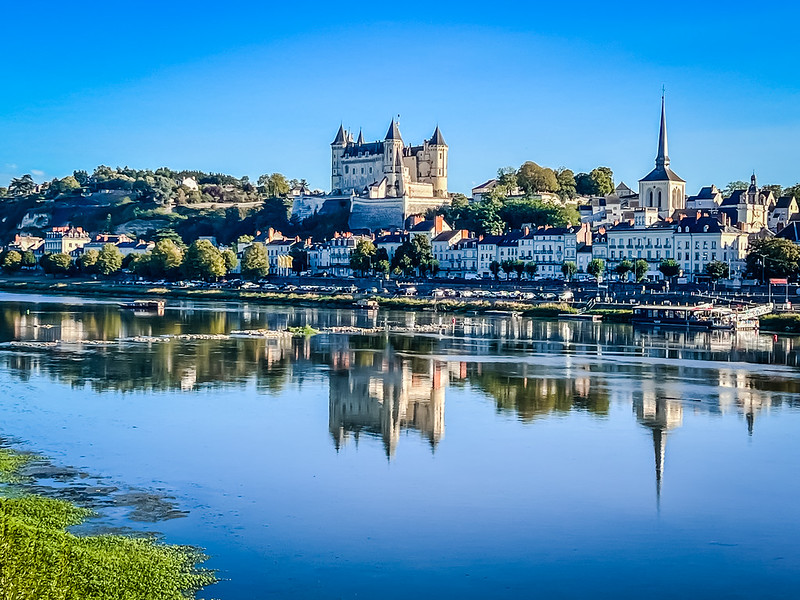
Proudly perched on a rocky spur (aptly nicknamed the "Emerald Rock" by René I d'Anjou), the Château de Saumur towers 60 meters above the royal river and blends magnificently into the landscape.
With its ramparts, tuffeau walls, white Loire stone and slate roof, it's visible from 20 kilometers around and instantly recognizable. It's even more majestic now that one of the golden finials that stood atop each of the castle's towers in the 15th century has been restored to its south tower.
At its foot flows the Loire, which divides here to flow around the Ile d'Offard, before welcoming Le Thouet, one of its many tributaries, a few hundred meters further down.
This is Saumur's must-see attraction.

The château loves to be reflected in the river, and we invite you to admire this incredible natural tableau from the right bank, near the Cessart bridge. All the beauty of the eternal Loire...
WHERE TO STAY IN Saumur
Downtown
Enjoy the city, its restaurants and beautiful architecture.
- Hotel Saint Pierre - a historic stay! - see prices, pictures and availability
- Hotel Château La Marquise - prices, pictures and availability
- Hotel Anne d'Anjou - prices, pictures and availability

In the countryside around
Looking for a bit of peace and quiet, without straying too far from the city of Angers? Here's our suggestion:
- Hotel Demeure de la Vignole - prices, pictures and availability
- Hotel Joly Foudres - unusual in barrels - prices, pictures and availability
- Hotel de l'abbaye de Fontevraud - prices, pictures and availability

History in brief
Unfortunately, our knowledge of the history of the Château de Saumur, particularly in the Middle Ages, is patchy and uncertain. The whole thing is rather poorly documented, or the writings were destroyed during the castle's tumultuous life. The oldest pictorial representation is said to appear in the"Très riches heures du Duc de Berry" (a prayer book rich in illuminations).

- Middle Ages: The first constructions were ordered in the 9th century by Thibaut de Blois, to protect the nearby abbey of Saint-Florent-du-Boile. Destroyed in the 11th century by the formidable Count of Anjou, Foulques Nerra, he had a powerful residential tower built in its place. It wasn't until the early 13th century that a fortress was built, which was transformed into a palace by the dukes of Anjou-Valois in the 14th century.
- Renaissance: the château became part of the royal domain in 1480, on the death of the last Count of Anjou, the good King René. After being abandoned for 1 century, it became a utilitarian château and the home of the city's governors for almost 4 centuries. The most famous of these governors was Philippe Duplessis Mornay, who made Saumur a Protestant stronghold and contributed to the castle's renewal.

- Revolution: the château fell into disrepair over the centuries and was used alternately as a prison (with a few "star prisoners", such as the Marquis de Sade and Louis XIV's superintendent, Fouquet...) and as an arms and munitions depot, until it was acquired by the town of Saumur in 1906, which restored it and opened it to the public.
Practical tips and map Château de Saumur,France
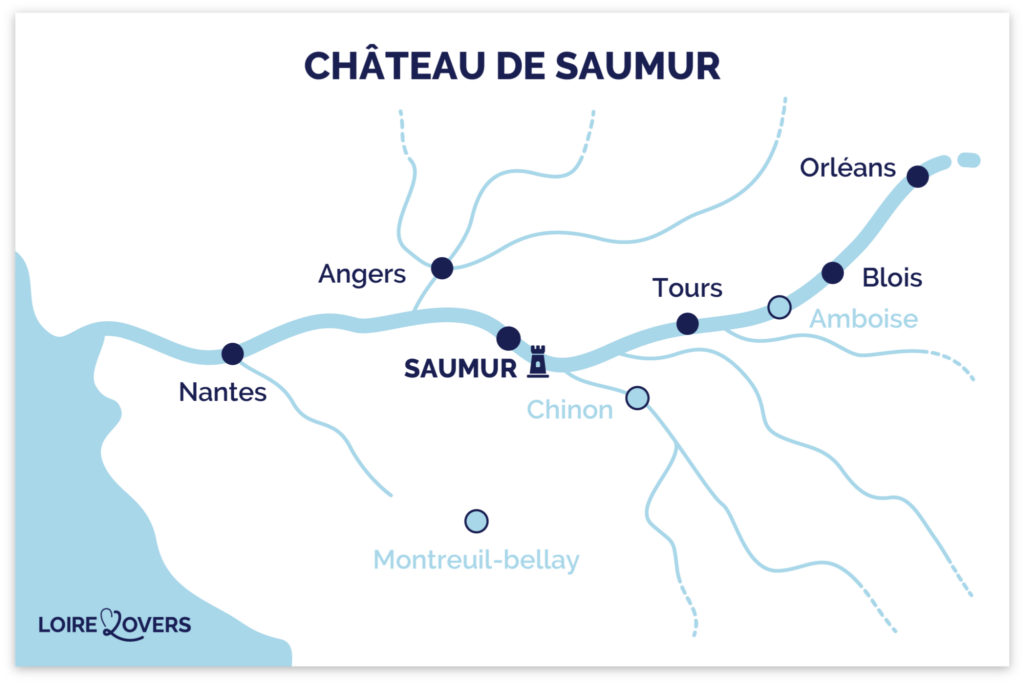
Where to find Château de Saumur
- Driving time from Nantes: 1h35
- Driving time from Tours: 1h00
- Driving time from Angers: 45min
- Driving time from Blois: 1h30
- Driving time from Orléans: 2h00
Here is a map to help you find your way:
How to get there
To get to Saumur, you can opt for the train, with regular connections from the Angers (20') and Tours (40') TGV stations, which are less than 1h30 from Paris.
The Saumur train station is on the right bank of the river, and it will take you half an hour to reach the entrance to the château (with a steep climb to the end, but with a fine view of the château all the way).
If you're coming by plane, be sure to compare the flights landing at Nantes airport with those arriving at Paris airports. While the train journey time to Saumur will be the same, the more human-sizedNantes international airport could save you time in the end.
Of course, you can also come by car, as the town has excellent transport links, with a freeway taking you right to the city gates. If you're coming from Angers or Tours, don't hesitate to take the route de la levée, which will take you along the Loire and only 15' further than the freeway. In autumn and spring, the sight of mist rising from the river is just magical!
OUR TIPS FOR RENTING A CAR IN Loire
- Compare prices on our preferred platform: DiscoverCars - one of the best rated sites.
- Choose a fairly compact car (many villages have narrowed the road).
- Think aboutfull insurance (parking in big cities is really tight).
- There is a lot of demand, book it early.

Parking

The château has its own dedicated parking lot, free of charge. It's just 50 meters from the Château entrance. Relatively modest in size, it can fill up quite quickly during peak summer and weekend periods. Motorhomes are allowed and you'll find 2 electric hook-ups.
You can also opt topark in the center of Saumur and walk up the old streets to the château. Parking is often charged, but you should be able to find a space easily.
Located in the heart of the Loire à vélo route, you'll find plenty of space to park your bike safely.
Best time to visit Château de Saumur
No particular constraints on the visiting period, as most of the visit is indoors. However, to enjoy the beautiful view from the belvedere and the reflections of the château on the Loire, a sunny sky will only enhance the experience.

The Château de Saumur is attracting an increasing number of visitors, thanks to the town's new tourist dynamic. Like all castles, the school vacations and summer months are the busiest. If you arrive early in the morning, or end your day's visit at the castle, you should be able to escape the crowds.
On weekends, the castle also attracts many locals looking for a day out.
How long to visit the castle and main difficulties
We recommend that you allow at least 2 hours for your visit to the Château de Saumur.
To access the castle from the parking lot, you'll need to take into account that, for those prone to vertigo, you'll need to cross a footbridge over the moat. If this is a problem for you, you can climb up to the castle via the town center, thus bypassing the difficulty.

As soon as you enter the castle, you can't escape the steps, and you'll encounter more of them at every stage of the visit, some of them quite steep. It should also be noted that the ground in the courtyard and basement is not always even.
If you're planning to climb up to the lookout, make sure your knees are in good shape and your shoes are suitable. The staircase is particularly steep and cramped, but the view at the top will be a fitting reward for your efforts!
A LITTLE MORE patience
All the photos, maps, information, good addresses to make your stay in the Loire Valley a success, will soon be gathered in a single ebook!
Advice on how to visit
As you can see, the Château de Saumur is first and foremost admired in its surroundings.
We recommend starting from the right bank, near the Cessart bridge, and walking up to the castle through the narrow streets of the historic town center. The walk takes about 30 minutes. For us, it's the best way to discover what makes the castle so charming.

Once you've arrived at reception, if you're feeling well enough, start by booking your visit to the belvedere at the entrance. As access is very restricted, it is only accessible with a guide, in groups of 8 people, and takes 30 minutes.

A few steps and you're in the château courtyard. Take the time to look at the exterior architecture and discern traces of theformer west wing (probably destroyed in the early 17th century, and which housed the gallery of honor, with an unobstructed view of the Loire), whose gable can still be seen, and the jambs of a chimney on the south wing.

On the first floor, you can discover the magnificent well, with its wooden mechanism enabling it to draw water from the water table 33 metres below! It supplied the château with water until the end of the 19th century. In the south wing, a room recounts thehistory of the château and its museums, so essential given the turbulent history of the château.

On the 1st floor, you'll find the surprising Musée des Arts Décoratifs, a patchwork of collections from the former municipal museum and from donations. It features a collection of 1,500 ceramics and beautiful tapestries from the Notre-Dame de Nantilly church in Saumur.

On the 2nd floor, you'll find a museum dedicated to horses, a logical choice in a town that is one of France's leading equestrian centers, with the prestigious Cadre Noir de Saumur and theEcole Nationale d'Equitation. Drawing on a wealth of 7,200 objects, the museum offers an insight into the world of the horse through the centuries.

Finally, if your knees can take it, you can go down to the tunnel entrance in the basement of the south wing. Local legend has it that an underground passage leading from the château leads directly to the right bank of the Loire, to the island of Offard. Can you solve the mystery?

Before setting off again, take time to admire the castle from the bailey , which offers a different view of the castle and an interesting panorama (although not quite as good as the belvedere!). Take a tour of the walled enclosure to admire the different facades from a different angle.

On the way back to the parking lot, take a break in the vineyards. You can admire 1,400 plants, with 3 grape varieties: chenin, cabernet franc and chardonnay. For many years, wine from the château was served at all the town'sofficial events! They are now in the hands of students from the Lycée Pisani in Montrueil-Bellay.

Château de Saumur with children
Every school vacation, the castle teams offer a Little King and Princess workshop, an escape game... a fun way to visit the castle. Places are very limited, so book as early as possible(find out more about children's activities at the Château de Saumur).
Or opt for the "Saumur Castle Investigation" game booklet, which will take them from room to room in search of clues to the castle's secret code...
Schedules and prices
Schedules:
- The château is open all year round, except in January.
- Out of season, the château is open Tuesday to Sunday, 10am to 1pm and 2pm to 5:30pm minimum.
- From April to August, the château is open daily from 10am to 7pm.
Rates:
- Full adult rate: €9.50
- Children's price: 7€ for 7 - 16 year olds, free for children under 7.
- Family rate: €24 - 2 adults + 2 children (€1.50 per additional child)
Consult the latest prices/times on the official Château de Saumur website
HAVE FUN WITH THESE activities

Guided tours
The château has a large team of mediators (with whom we had lots of discussions....) and offers a wide range of activities:
- presentations of the site's history and architecture (30')
- guided tours of the Musée des Arts Décoratifs (1h)
- guided tours of the north-west tower leading to the belvedere (30')
Catering
2 restaurants await you at the foot of the château:
- L'orangeraie offers home-style bistro cuisine, but is also a very pleasant place to recharge your batteries with a cool drink after your visit.
- Le Terrier du Château, a tapas bar and restaurant located not far from the parking lot, for family meals overlooking the castle (and your car).

But you can also go down to the old town (10' walk), and take advantage of all Saumur's gastronomic offerings, which we'll tell you about below.
If you'd like to picnic, the château gardens are open every lunchtime!
Subscribe to our Newsletter
- Get away from it all with Region Lovers' beautiful destinations!
- Once a month
- Advertising-free

Was the double spiral staircase invented by Leonardo da Vinci?
If this isn't your first Loire château, you've probably already heard of theincredible double spiral staircase at Château de Chambord. It is said to have been invented by the Italian genius Leonardo da Vinci. But is it true?
The south wing of the Château de Saumur
This wing was the last to be built (circa 1384-88) under the direction of Marie de Blois, mother of the young Louis II d'Anjou. It houses the Duke's personal guard (Lieutenant, Captain and Guards). His private apartments, as evidenced by the paintings uncovered, are located in the famous southwest tower, which we'll tell you about next, and are thus well guarded.

In the 16th century, the governor of Saumur, Duplessis-Mornay, had 26 rooms in the château renovated to accommodate his 3 daughters, their husbands and grandchildren, as well as his bodyguards and servants. The south wing was then divided into smaller rooms, and switched to a more residential vocation.
When the château was converted into a state prison in the early 19th century, this wing was used to house the prison cells and was partially disfigured.
The spiral staircase
At the end of this wing stands the castle's southwest tower . At its heart is the famous double-helix or double-revolution spiral staircase, which allows access to all floors without ever crossing each other. It served the duke's bedroom, with its 8-meter-high ceiling, and his wife's, discreetly located just below.

The staircase must have been built in the late 14th century, more than a century before the Château de Chambord was built! The staircase at the Château de Saumur was itself inspired by the "Grande vis" spiral staircase at the Louvre, designed by architect Raymond du Temple. In the 14th century, he designed the new Louvre, and was already faced with the problem of limited space (the price of a square meter in Paris in the Middle Ages...). It must have been one of his disciples who worked on the Château de Saumur.
These 2 cases are not isolated: you'll find the same type of staircase in the Saint Nicolas tower guarding the entrance to the port of La Rochelle, whose construction began in 1345. 1 in Prague Cathedral, designed by the French architect Matthieu d'Arras, work on which began around 1342! Today, a total of 5 staircases of this type and era remain in Europe.

As is often the case with inventions, even if a great name goes down in history, we're talking about a gradual evolution, culminating in the majestic double-revolution staircase at the Château de Chambord in the early 16th century. But, we agree, it's certainly the most beautiful of the double-revolution spiral staircases, and it's likely that Leonardo da Vinci took a closer look at its initial plans.
The belvedere and finial
Once you've climbed the staircase, you'll arrive at the château's belvedere, where you can enjoy a 360-degree view of the town, the river and the Saumur countryside. On a clear day, you can see for up to 30 km, as the landscape is so unobstructed here. Following the course of the Loire, you look towards Angers, then back up towards Tours.

If you turn away from the Loire, you'll be able to decipher the complex assembly of the château's slate roofs, giving you a better understanding of the château's volumes and organization.

The highlight of this discovery is the finial on the south tower. Featured in the "Riches heures du Duc de Berry", its ornamental pieces further enhanced the château's prestige. Having disappeared over the centuries, it wasn't until 2015 that the château was able to recover one of these unusually large finials:
- 12.5m high.
- 12,000 gold leaf for its production.
- Over a ton and a half of lead.
- 2000 hours of work under the supervision of Anraud de Saint Jouan, Chief Architect of the Monuments Historiques.
DISCOVER Saumur
- Best things to do in Saumur
- Where to sleep in Saumur: best hotels
- Where to eat in Saumur: best restaurants
- Visit the Château de Saumur
- Visit Fontevraud Abbey
- The most beautiful castles around Saumur
- Saumur's troglodytes
- itineraries: weekend
Should you visit the Musée des Arts Décoratifs?
A little history
The Musée des Arts Décoratifs is the fruit of a history that began in 1829. It was at this time that the municipal museum was founded, focusing on archaeology and zoology.
In 1906, the town acquired the château and moved the new museum there in 1912. The collection has been enriched by some fine donations (including paintings by Parisian artist Paul-Désiré Trouillebert and the herbarium of Angevin entomologist Gustave Abot).
But the turning point for the museum came with the bequest of Charles Lair in 1919.
The Charles Lair donation
Count Charles Lair was a passionate silver collector (1841-1919). After studying law, he travelled around Europe and the Mediterranean to feed his 2 passions, archaeology and art.

He is both an inspector for the Société française d'archéologie (for Sarthe, Mayenne and Maine-et-Loire), and a member of the Acédémie des sciences, belles lettres et arts d'Angers.
His château in Blou (near Saumur), also known as "Les Perrières", houses an extraordinary cabinet of curiosities, with a predilection for objects from the Haute Epoque (Middle Ages to the 17th century) and European earthenware.

On his death, he bequeathed his entire collection to the Château de Saumur, including 2,500 works and 7,000 ex-libris (personalized engravings glued to the inside of books). You'll find ceramics, furniture, textiles and sculptures.
The tapestries of Saumur
As a result of its religious past, the town of Saumur boasts one of the finest collections of tapestries, mainly from the 15th to 18th centuries, 62 of which are protected as historic monuments.

Over the centuries, they have been commissioned by the Saumur churches of Saint Pierre and Notre-Dame de Nantilly, as well as by the Abbey of Saint-Florent in Saumur, from France's leading lining workshops.
Many of these masterpieces are protected and exhibited at the Château de Saumur.
Museum organization
The museum occupies the entire1st floor, straddling the east and north wings. The rooms are named according to their use in the ducal palace. Each room features furniture, earthenware, sculptures, tapestries and paintings.
- The passageway, connecting the south and east wings. This is an addition to the original château plan.

- The Queen's bedroom, a semi-public room used to receive visitors.


- The Queen's salon

- The chapel, with its choir in the east tower.


- The facing room, a semi-public reception room.

- The chamber of withdrawal, where the duke and his government retired to deal with ducal affairs.


- The wardrobe.

- The gallery

DON'T MISS THE BEST CASTLES IN the Loire Valley
- The most beautiful castles of the Loire Valley
- The most beautiful gardens
- Where to stay in the Loire castles: unforgettable hotels!
- The best Loire castles to visit with your family
- Castles you can visit with a dog
- Chambord or Chenonceau: our comparison
- itineraries: weekend - 3 days - 4 days - 5 days - 1 week
- Castles around Blois, around Amboise, around Saumur, around Tours, around Angers and around Nantes.
- or our list of over 100 Loire castles

The Horse Museum
Saumur, capital of horse riding and the equestrian arts
The Pays de la Loire region is one of the largest in France, both in terms of the number of racecourses (1st) and the number of horse births (2nd).
With its military past and cavalry officers' school, the town of Saumur brings excellence to the table, with :
- The Cadre Noir de Saumur, which trains and perfects France's finest equestrians and has a worldwide reputation.
- The French Institute of Horse and Riding, which trains the executives of French horse riding, organizes the most important competitions and is responsible for preserving the French tradition of horse riding based on the harmony between man and horse.

It is also a place of memory with 2 museums:
- The Saumur Cavalry Museum, which traces the history of the French cavalry from 1445 to the present day
- The horse museum of the castle of Saumur
The horse museum of the castle of Saumur
The horse museum, an associative structure at its creation, was inaugurated in 1912 at the same time as the municipal museum was installed in the castle of Saumur. The objective of this museum was to defend the use of the horse, in the face of the appearance of automobiles.
In 1957, the collections, the fruit of donations from private individuals and large institutions, were integrated into the collections of the municipal museum.
Located on thesecond floor of the castle's east wing, the museum is housed under a magnificent wooden frame in the shape of a ship's hull, and extends to the northeast tower.
The collection now contains more than 6,000 objects, ranging from the Neolithic period to the 20th century. You will find shoes and farrier's instruments as well as works of art on the equestrian theme.

In the tower, a very nice collection of saddles from different continents (special mention to the Japanese saddle).

Virtual video tour of the château
PLAN YOUR TRIP IN
Loire Valley
The castles of the Loire Valley

Other places to explore

Practice