
Not to worry. Here is our complete guide to driving in the Loire Valley, including:
- Safety and driving difficulties
- Rules of conduct
- Road conditions
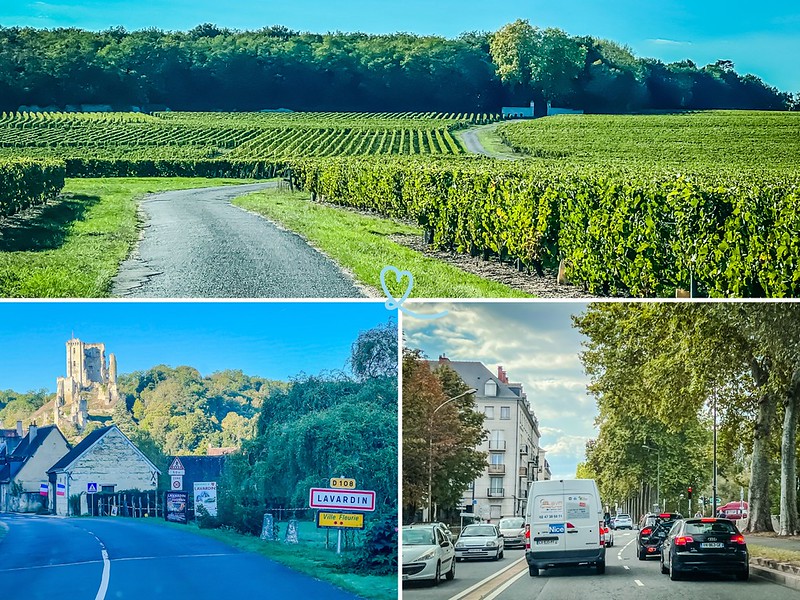
This guide is completely independent, based on our experiences. We visited the region anonymously, making our own choices and paying our bills in full.
Driving in the Loire Valley: What You Need to Know
If you don't want to read the whole article, at least read this short summary of the essential points to know:
- Driving is on the right side of the road.
- The minimum driving age is 18, but some rental agencies may require drivers to be older.
- Seatbelts are compulsory for everyone.
- The legal blood alcohol limit is 0.05%, and 0.02% for novice drivers (those who have held a license for less than 3 years).
- Speed limits are clearly marked in a red circle.

- Items to Bring – reflective warning triangle, reflective vest.
- In towns and villages, when you come to an intersection without a sign (stop or yield), the vehicle coming from the street on the right has the right of way. And you have the right of way on the streets to the left.
- Do not drive into the centers of old villages or the narrow streets near castles if you are driving a motorhome or a large van.
- In case of an accident—emergency number: 112.
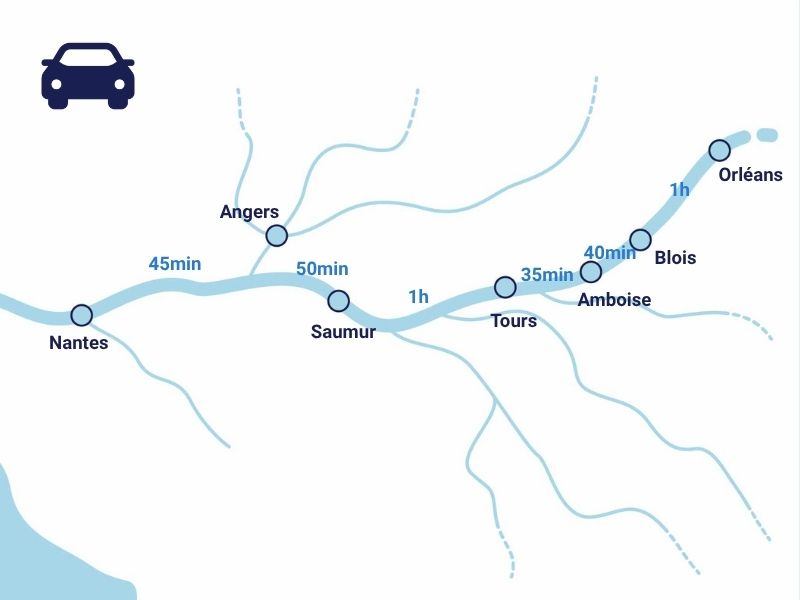
Here are the driving times in the region, to give you an idea of how to get around:

1. Renting the Right Car in the Loire Valley
To make driving easier, it's best to choose a car adapted to the type of road and conditions. For the Loire Valley, we recommend:
- An average-sized bike is sufficient; most roads are wide and well-maintained
- A compact model makes it easier to park in historic city centers such as Amboise or Blois
- An automatic transmission is still a plus if you're not used to driving in France, especially with all the roundabouts
- Learn more in our article on how to rent a car in France.
- >> See great rental offers on our preferred platform

2. Know the rules of conduct
License, age, documents
To drive in the Loire Valley—as in the rest of France—a valid driver’s license from your country is sufficient, provided it includes a license number, a photo, an expiration date, and is written in the Latin alphabet. In that case, an international driver's license is not required.
If your driver's license does not meet these criteria, you must also bring an International Driver's Permit.
The minimum age for driving in France is 18. You are also required to carry your vehicle registration documents and a valid form of identification, such as your passport, with you at all times.

General rules
- In the Loire Valley, people drive on the right side of the road.
- Seat belts are required for all occupants.
- No cell phones held in your hand while driving.
- Headphones and earbuds are prohibited.
- Children under 10 years of age are not allowed to sit in the front seat of the car.
- The "yield to the right" rule applies in most villages and on most small roads without signs—a rule that often surprises foreign travelers.
Alcohol and driving
The legal blood alcohol limit is 0.05%, and it drops to 0.02% for novice drivers—that is, those who have held their license for less than 3 years. Driving under the influence is considered a serious offense.

We always recommend not drinking at all if you’re driving, especially since the region offers plenty of opportunities for wine tastings at its many wineries (Vouvray, Chinon, Bourgueil, Saumur…), which is a good reason to designate a designated driver for the day.
Mandatory in-car equipment
In France, the following items must be available in the car:
- A warning triangle
- A reflective vest, kept within easy reach inside the vehicle rather than in the trunk
- A spare tire and the tools needed to change it, or a repair kit, depending on the vehicle
- Children shorter than 135 cm must be secured in an appropriate car seat or booster seat

Compulsory insurance
The only type of insurance that is mandatory in France is liability insurance, also known as third-party insurance. It is automatically included in the price of all car rentals. If you're coming with your own vehicle, don't forget to bring proof of insurance.
WHERE TO STAY IN THE Loire Valley
Our independent picks for the accommodation of your dreams:


3. Preparing for different types of road
Highways
The A10 highway runs through the region from north to south, connecting Orléans, Blois, Tours, and Poitiers. The A85 completes the network to the west, toward Angers and Saumur. These roads are toll roads, with either automated or staffed toll booths, and provide quick access to the major cities in the valley.

Country roads and small roads
The departmental roads that run along the Loire, such as the D751 and the D952, are toll-free and offer a more leisurely drive, making them ideal for exploring the castles at your own pace.
Away from the major highways, the Loire Valley is best explored on country roads, which are sometimes lined with vineyards or sunflower fields, depending on the season. They are generally in good condition, but are often narrow and winding on the outskirts of villages.
Traffic is light there except on summer weekends, which makes for a relaxing drive. Some sections, particularly those near the most popular castles such as Chambord and Chenonceau, may be more crowded during the high season.

4. Understanding signs and tolls
Speed limits
- Speed limits are indicated on circular signs with a red border and a number.
- Speed limits are expressed in kilometers per hour.
- The national speed limits are: 50 km/h in built-up areas, 80 km/h on regular roads (90 km/h on certain two-lane divided highways), and 130 km/h on highways (110 km/h in rainy conditions).
- There are a lot of speed cameras in the area!

Road signs
The road signs are standard, using the Latin alphabet; there's nothing specific you need to know. Tourist attractions and castles are marked on brown signs, which are very helpful for finding your way among the various roads that run along the river.

Tolls
The A10 and A85 highways are toll roads. On the other hand, none of the departmental roads in the valley have tolls, so you can choose between a faster trip on the highway and a toll-free route along the river.

HAVE FUN WITH THESE activities

5. Safety: understanding potential hazards
Is driving in the Loire Valley dangerous?
No, overall, driving in the Loire Valley does not present any particular difficulties. The roads are well-maintained, the signage is clear, and the terrain remains flat throughout the entire route.

In fact, we consider this region to be one of the most accessible in France for a road trip by car, even for drivers who aren't used to driving abroad. However, it is still essential to obey speed limits, especially when driving through towns.
You'll have the most trouble in the cities of Nantes and Tours, where there's more traffic. But that's really nothing compared to the major capitals.

Potential hazards
- Cyclists –
The region is very popular for bike rides, especially along the "Loire à Vélo" route. Be extra careful when passing them, especially on the narrow roads along the river. - Intersections in villages –
The "right-of-way" rule, which is not widely practiced in other countries, may come as a surprise to foreign travelers in small towns. - The smallest country roads -
The locals know them so well that they tend to drive faster

- Speed bumps where you must yield to oncoming traffic
- The Morning Fog –
Fog can set in early in the morning along the river, especially in the fall and winter, reducing visibility. - Landscapes –
Amid the castles, vineyards, and banks of the Loire, the main danger is getting distracted by the scenery rather than the road.

Specific driving tips
For roundabouts—which are common in the region—the rule is simple: drivers already in the roundabout have the right of way. Please yield the right of way when entering, unless otherwise clearly indicated.
When visiting the most popular castles, plan to arrive early in the morning—not only to enjoy the sights before the crowds arrive, but also to find a parking spot more easily.

What to do in the event of an accident
If anyone is injured or there is a conflict, the emergency number is 112. The best order of action is:
- contact the emergency services
- contact the police
- contact your rental provider
6. And the rest: parking, fuel...
Fuels and service stations
- Unleaded gasoline is called "unleaded 95" or "98."
- Diesel is called "gasole."
- Large retail stores located on the outskirts of cities generally offer the cheapest fuel in the region.
- Electric vehicle charging stations can be found in most major cities, such as Tours, Blois, and Angers.
Parking in town

In cities like Tours, Blois, Orléans, or Angers, the easiest option is to park in an underground garage or on the outskirts, since the city center often has traffic restrictions or limited parking spaces. Parking in the blue zone requires a parking disc, and paid parking zones use parking meters.
Parking at the attractions
Near the most popular castles, such as Chambord and Chenonceau, the parking lots are large but fill up quickly during peak season. We recommend arriving early in the morning so you can find a parking spot easily and avoid the crowds.

Frequently asked questions
Do you need a car in the Loire Valley?
It depends on what you're looking for in your trip. Some castles, such as Chambord and Amboise, can be reached by train from Tours and then by shuttle or bike. But to freely explore the entire valley, its vineyards, and its villages, we strongly recommend renting a car. This allows you to plan your own itinerary without having to rely on public transportation schedules, which are often limited outside of major cities.
Is it necessary to rent a 4WD vehicle in the Loire Valley?
NO. There's really no need to rent a 4WD in the Loire Valley. Almost all the roads are paved and in good condition, and the terrain is flat, requiring no special motorized vehicle. A city car or compact car will be more than enough for the entire trip.
PLAN YOUR TRIP IN
Loire Valley
The castles of the Loire Valley

Other places to explore

Practice