
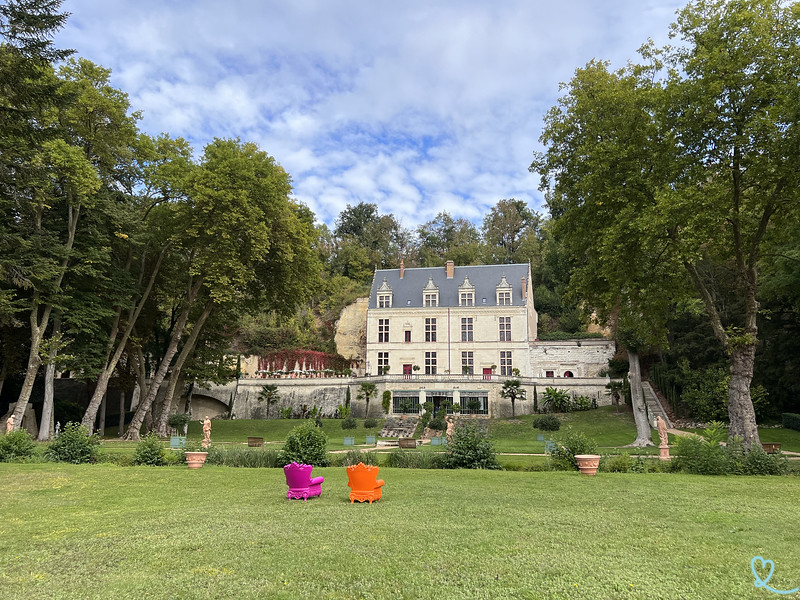
Nestled in a verdant valley in the heart ofAmboise, Domaine du Château Gaillard is much more than just a Loire château. Here, you enter the Italian dream of Charles VIII, who brought back from his 15th-century campaign in Naples an art of living unheard of in France. Renaissance gardens, an orangery, lush parkland and a residence resembling an Italian palazzo form a unique ensemble. We discovered an astonishing place, both intimate and prestigious, which tells another side of the story of Amboise and the kings of France.
In this article, you'll find some useful tips to help you prepare for your visit and have a wonderful time!
This guide is completely independent, based on our experiences. We visited the region anonymously, making our own choices and paying our bills in full.
Why visit Château Gaillard?
Is Château Gaillard worth it? Our opinion:
Yes, absolutely! We loved visiting Château Gaillard, an interesting and unexpected site. It's not the largest of the Loire castles, but it offers a different experience: an immersion in Italian Renaissance art, through its elegant architecture, gardens and the story of visionary gardener Dom Pacello. You'll experience an intimate atmosphere, far from the crowds, with the impression of entering a carefully preserved private domain. For us, it's a must-see if you're exploring Amboise.
This is one of Amboise's top attractions.

Our favorite moments
Our highlights include
- discover apartments decorated in the spirit of the 16th century, where every fireplace, stained-glass window and woodwork panel tells a story.
- We also particularly enjoyed strolling along the 7 Paradiso trails, taking in the views of the Jardins du Roy.
- And then there was the discovery of the rare orange and citrus trees in the orangery, which left a memorable impression.

History in brief
In 1496, Charles VIII returned from his Italian campaign fascinated by the beauty of the quattrocento (Italian for "fifteenth century"). He commissioned the Italian architect Fra Giocondo to build the Château Gaillard in Amboise, where he installed Dom Pacello de Mercoliano, a Neapolitan gardener considered the greatest of his time. Pacello created France's first Renaissance gardens and acclimatized the country's first orange trees. Over the centuries, the estate passed through the hands of illustrious figures such as Louis XII, François I, René de Savoie and Cardinal de Guise. Rediscovered after 5 centuries of neglect, Château Gaillard was reborn in 2014 thanks to a meticulous restoration.

WHERE TO STAY IN Amboise
Downtown
To enjoy the city, its restaurants and castles, we recommend:
- Hotel Le Manoir Saint Thomas - view prices, pictures and availability
- Hotel Le Manoir des Minimes - prices, pictures and availability
- Hotel Au Charme Rabelaisien - prices, pictures and availability

In the countryside around
Charming places nearby. We recommend..:
- Hotel Château du Perreux - prices, pictures and availability
- Hotel Château de Pray - prices, pictures and availability
- Hotel Chateau de Nazelles - prices, pictures and availability


Access and map: Château Gaillard, Amboise
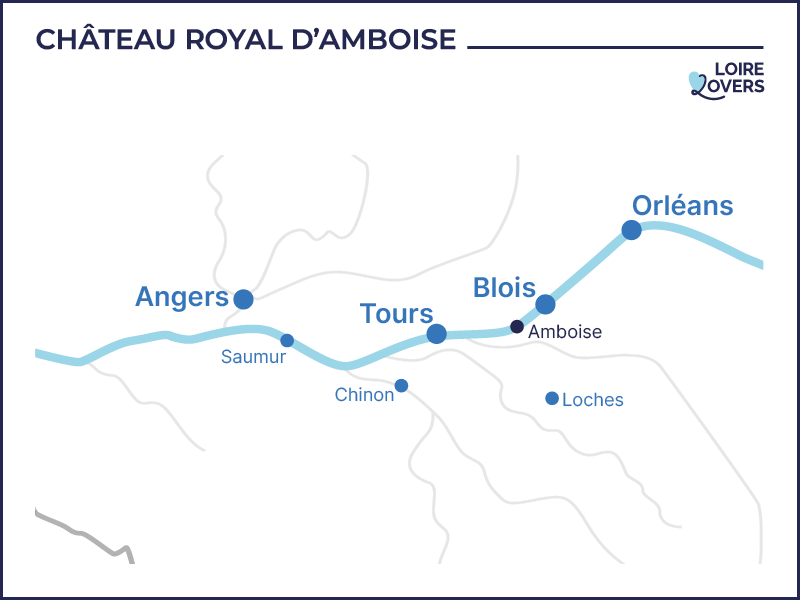
Where is Château Gaillard?
The Domaine du Château Gaillard is located in Amboise, Indre-et-Loire, in the heart of the UNESCO World Heritage Loire Valley.
The château is just a 10-minute walk from the center of Amboise and the famous Château Royal, making it easy to combine several visits during the day. It's also close to Le Clos Lucé, the last home of Leonardo da Vinci, less than 1 km away.
- Driving time from Nantes: 2h30
- Driving time from Tours: 25 min
- Driving time from Angers: 1h40
- Driving time from Blois: 30 min
- Driving time from Orléans: 1h10
Here is a map to help you find your way:
How to get there?
You can then reach the city of Amboise by train or by car.
By train, 2 options:
- via the Tours-Saint-Pierre-des-Corps TGV station (8 trains per day between Tours and Paris for an average journey time of 1 hour and 10 minutes) then Amboise (14 trains per day and 18 minutes journey time).
- Direct link by INTERCITES from Paris gare d'Austerlitz to Amboise station in less than 2 hours.
- From the Amboise train station to the castle, it will take about fifteen minutes to walk.

Parking
Free parking is available at 99 Avenue Léonard de Vinci, in high season: May 1 to August 31.
OUR TIPS FOR RENTING A CAR IN Loire
- Compare prices on our preferred platform: DiscoverCars - one of the best rated sites.
- Choose a fairly compact car (many villages have narrowed the road).
- Think aboutfull insurance (parking in big cities is really tight).
- There is a lot of demand, book it early.
Useful tips: duration, schedules, eating...
Best time to visit
We recommend visiting Château Gaillard in spring or early summer, when the gardens are in full bloom and the orangery releases its intoxicating fragrances. Autumn is also superb, with the park's warm colors. In winter, on the other hand, the gardens are quieter, but the interior of the château and the exhibitions are still of great interest. To avoid overcrowding, choose mornings or late afternoons.

Length of visit and main difficulties
Allow between 1h30 and 2h30 to fully enjoy the château, gardens and park.
The tour is generally accessible, but bear in mind that some paths are steep and the castle's ancient staircases can be steep. We advise you to wear good shoes if you wish to explore the park's trails.

Advice on how to visit
- Start with a tour of the château's apartments to immerse yourself in the Renaissance atmosphere,
- then continue with the orangery and its citrus fruits.
- End your visit with a stroll through the park and gardens, following the 7 paths of Paradise.
This route allows you to gradually build up in intensity and finish with a natural immersion and panoramic views.
Here's the site map:

A LITTLE MORE patience
All the photos, maps, information, good addresses to make your stay in the Loire Valley a success, will soon be gathered in a single ebook!
If you wish to be informed of the publication of our guide on the Loire, register:
Visiting with children
We found the tour very family-friendly!
- The gardens and park provide the ideal setting for children to marvel and run around freely.
- They'll love the olfactory grotto, with its play on scents.
- Certain exhibits (such as curiosities and unusual objects) will also arouse their curiosity.
Please note, however, that the castle's staircases are impractical for baby carriages, so it's best to bring a baby carrier if you're visiting with very young children.

Schedules and rates
- The estate is open daily from 10am to 6pm.
- Tickets cost €17 full price and €15 concessions.
More info on the official website, here.

Guided tours
Guided tours are available and included in the ticket price. We highly recommend them: they provide a better understanding of the castle's history, Dom Pacello's innovations and the stages of restoration. Timetables are available on site.

Catering
Lunch and snacks are available on site between 11am and 6pm.

You can also picnic in the park on the tables provided:

Subscribe to our Newsletter
- Get away from it all with Region Lovers' beautiful destinations!
- Once a month
- Advertising-free

Le Château: a small Italian palace in the Loire Valley
Discover the royal apartments

As we entered Château Gaillard, we had the feeling of stepping back into Quattrocento Italy ("fifteenth century" in Italian). This " palazotto " (small palace) built by Charles VIII, who was dazzled by his campaigns in Italy at the end of the 15th century, reveals a refined and warm art of living. You'll appreciate the richly furnished rooms, sculpted fireplaces with delicate pediments and colorful stained glass windows that evoke a nascent Renaissance, imported by Italian artists invited to France.

We enjoyed exploring these spaces, where every detail - an ornate bay window, a polychrome medallion, a discreet fresco - tells the story of a young king's dream to transform Amboise into the capital of modernity.
Explore the castle's sights

Beyond the apartments, Château Gaillard is full of surprises. You'll discover a fascinating cabinet of curiosities, combining unusual objects and witnesses to bygone eras: a 4-million-year-old meteorite, a medieval "mask of shame" and figurines inspired by the Commedia dell'Arte.

We also found evocations of legends, such as Anne de Bretagne's beloved Unicorn. This accumulation of stories and unusual objects makes the visit lively and almost theatrical, reflecting the political conciliabula and historical intrigues that took place within these walls.
L'Orangerie: a Mediterranean setting in Touraine
France's first orange trees

Imagine the intoxicating scent of orange blossom in a Loire valley: it was at Château Gaillard that it first spread to France! Here, Dom Pacello de Mercoliano, a Neapolitan monk-gardener considered the greatest gardener of his time in Europe, acclimatized the first orange trees at the turn of the 16th century.

We were impressed by the diversity of the current conservatory: almost 200 lemon and orange trees, including over 70 varieties, from kumquat to bergamot, combava and Thompson orange. As you stroll through the orangery, you'll be following in the footsteps of kings and botanists who marveled at these Mediterranean treasures.
Orange tree crates and the legacy of Dom Pacello

Château Gaillard was also a laboratory for horticultural innovation. It was here that Dom Pacello invented the famous orange tree crates, enabling the trees to be protected in winter and moved with the seasons.

A visit to the orangery and its walled gardens gave us an idea of the ingenuity of this man, who created much more than a garden: a veritable paradise on earth for Charles VIII. The walk gave us the impression of traveling between Italy and the Loire Valley, in an atmosphere where botany and the art of living are intertwined.
The park: between nature and curiosities
Stroll through 15 hectares of park and forest

The Château Gaillard estate extends over 15 hectares, combining centuries-old forest, clearings and belvederes. We loved wandering along the paths, between century-old plane trees, sculpted box trees and a Gallo-Roman spring. Keep your eyes peeled along the way, as it's not unusual to catch a glimpse of the park's wildlife: fox cubs, fawns, squirrels and hedgehogs.

This natural setting, preserved without chemicals, is testimony to the estate's commitment to sustainable tourism. A detail that's important to us. The promenade also offers superb views of the Jardins du Roy, which you can admire from several terraces.
The olfactory grotto and troglodytic spaces

Château Gaillard isn't just a surface visit: its troglodytic caves are a treasure trove of original experiences. We particularly liked the olfactory grotto, a playful area where you are invited to test your sense of smell by recognizing different citrus essences.

Nearby, other caves bear evocative names such as Grotte du Diable, which adds a touch of mystery to the visit. These unusual spaces enrich your discovery, combining botany, curiosity and imagination. Perfect for kids!
Les Jardins du Roy: between innovation and poetry
A land of horticultural innovation

Strolling through the Jardins du Roy, we became aware of Dom Pacello's audacity. In 1500, this Neapolitan genius created an experimental garden unique in France. Did you know? This is the birthplace of the famous Reine-Claude plum, dedicated to Claude de France, future wife of François I!

Holly-lined avenues, elegantly trimmed fruit trees and flowerbeds evoking the "rivers of Paradise" (water, milk, honey and wine) create a refined scenography. These innovations foreshadowed the French-style parterres that would later make royal gardens famous.
Wander the 7 paths of Paradise

The "7 Paths to Paradise" invite you to take a poetic stroll through gardens, forests and fountains. We've learned that the name "Paradise paths" comes from a tradition inherited from the Renaissance, when gardens were conceived as symbolic representations of earthly paradise. Here, Dom Pacello imagined 7 paths winding through the valley.

We particularly enjoyed the murmur of the Fountain of Youth, mingled with birdsong. In these gardens, time seemed to stand still: every bend in the path revealed a new perspective, a scent of rosemary or lavender, a line of orange trees or a belvedere overlooking the valley. It's a complete sensory experience, immersing you in the dream of paradise on earth envisioned by Charles VIII and his gardener.
PLAN YOUR TRIP IN
Loire Valley
The castles of the Loire Valley

Other places to explore

Practice