
Visiting southern Touraine? Don't miss the Musée de la Préhistoire du Grand-Pressigny. Nestled in a château at the crossroads of Poitou and Touraine, this exceptional site plunges us into 100,000 years of human history, from the Palaeolithic to the Bronze Age. We particularly appreciated the way the museum combines medieval, Renaissance and contemporary architecture to showcase its remarkable archaeological and paleontological collections.
In this article, you'll find some useful tips to help you prepare for your visit to the Musée de la Préhistoire du Grand Pressigny near Loches.
This guide is completely independent, based on our experiences. We visited the region anonymously, making our own choices and paying our bills in full.
Why visit the Musée de la Préhistoire du Grand-Pressigny?
Is the Musée de la Préhistoire du Grand-Pressigny worth it? Our opinion:
Yes, the Musée de la Préhistoire du Grand-Pressigny is well worth a visit. We were fascinated by the richness of the collections, which cover 100,000 years of history, and by the educational approach, which makes prehistory accessible to all.
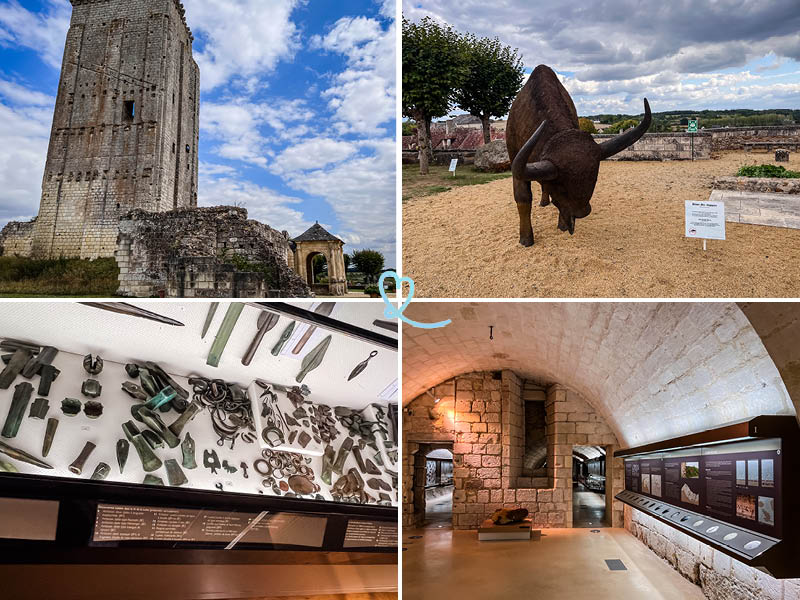
You'll also love the life-size animals at the museum entrance!

Why is the Musée de la Préhistoire famous?
The Musée du Grand-Pressigny owes its international renown above all to its exceptional flint deposits, a veritable treasure trove that made the site a major industrial production center exporting throughout Europe in the Final Neolithic (3rd millennium BC). In addition to this archaeological wealth, the castle is distinguished by its atypical setting: a thousand-year-old castle where medieval keep, Renaissance gallery and contemporary architecture interact.

History in brief
The Musée de la Préhistoire du Grand-Pressigny occupies a site steeped in history:
- 12th - 13th centuries: construction of the medieval fortress by the Lords of Pressigny on a strategic frontier zone.
- 16th century: Conversion into a Renaissance château by Honorat de Savoie-Villars.
- Revolution & 19th century: Sold as national property, the château was dismantled and used as a stone quarry before being bought back and saved by the public authorities.
- 1955: Installation of the Museum of Prehistory.
- 2009: Major renovation and addition of a modern building.

WHERE TO STAY IN Tours
In the city center
Enjoy the city, its restaurants and beautiful architecture.
- Hotel Ferdinand - check prices, pictures and availability
- Hôtel du Cygne - check prices, pictures and availability
- Hotel L'Adresse - check prices, pictures and availability

Near the station and around the city center
An early train? Or just a little more peace and quiet? Here are our recommendations:
- Hotel Les Trésorières - 5 stars - check prices, pictures and availability
- Aparthotel Central Parc Tours - check prices, pictures and availability
- Hotel Oceania L'Univers Tours - check prices, pictures and availability

In the countryside around
Looking for a bit of peace and quiet, without straying too far from the city of Tours? Here's our suggestion:
- Hotel Domaine de la Tortinière - 20 min away - check prices, pictures and availability
- Hotel Troglododo - unusual 25min away - check prices, pictures and availability

Access and map: Musée de la Préhistoire du Grand-Pressigny, Le Grand-Pressigny
Where is the Musée de la Préhistoire du Grand-Pressigny?
- In the village of Le Grand-Pressigny
- Driving time from Loches: 30min
- Driving time from Tours: 1h

How to get there?
The easiest way to reach the Musée de la Préhistoire du Grand-Pressigny is by car. The museum is located on a rocky outcrop on the borders of the Poitou and Touraine regions, in an unspoilt natural setting. From Tours, take the D910 towards Loches, then follow signs for Le Grand-Pressigny. The village is well signposted and the castle, which houses the museum, dominates the landscape.
OUR TIPS FOR RENTING A CAR IN Loire
- Compare prices on our preferred platform: DiscoverCars - one of the best rated sites.
- Choose a fairly compact car (many villages have narrowed the road).
- Think aboutfull insurance (parking in big cities is really tight).
- There is a lot of demand, book it early.

Parking
Free parking is available in the immediate vicinity. Find out more here.
Useful tips: duration, schedules, eating...
Best time to visit
We recommend you visit the museum on weekdays if you can, to avoid the weekend crowds. Mornings are the ideal time to enjoy the collections in peace and quiet. Please note that the museum regularly organizes events and workshops, so check the program in advance to enrich your visit.
Length of visit and main difficulties
Allow 1h30 to 2h to explore the entire museum.
The tour is accessible and presents no major difficulties.

Advice on how to visit
We suggest you start with the room devoted to the history of the château, to understand the evolution of the building that welcomes you. Take time to explore the tactile models that trace architectural transformations from the 12th century to the present day. Follow the chronological order of the archaeological collections, from the Palaeolithic to the Bronze Age. You'll appreciate the logical progression that allows you to grasp the evolution of techniques and lifestyles. Finish off with the paleontological section, to place human history in deep geological time.

A LITTLE MORE patience
All the photos, maps, information, good addresses to make your stay in the Loire Valley a success, will soon be gathered in a single ebook!
If you wish to be informed of the publication of our guide on the Loire, register:
Visiting with children
The Musée de la Préhistoire du Grand-Pressigny is the perfect place for a family visit. Fun and educational features will captivate young visitors. We've noticed that the museum's thematic approach, which explains in concrete terms the daily lives of men and women of the past, makes prehistory accessible to children. The museum also offers a creative space (photo below) and special events for young visitors throughout the year. Please ask when booking.

Schedules and rates
The museum is open daily in summer from 10am to 7pm.
During the off-peak season, opening hours are restricted.
The adult rate is €7.50. Admission is free for children under 7.
Find out more on the official museum website here.
Guided tours
While we appreciated the detailed explanations on the educational labels, nothing beats a guided tour! These visits break down clichés and reveal the complexity of prehistoric societies. Find out more about the program here.

Catering
There is no restaurant, but the site offers a picnic area and deckchairs in the shade of the artbes. The village of Grand-Pressigny also offers a number of dining options. For more choice, the town of Loches, a 30-minute drive away, offers plenty of other options.

Subscribe to our Newsletter
- Get away from it all with Region Lovers' beautiful destinations!
- Once a month
- Advertising-free
A museum in a castle
The Musée de la Préhistoire du Grand-Pressigny occupies a remarkable site, perched on a rocky spur on the borders of Poitou and Touraine. We were impressed by this exceptional setting overlooking the surrounding landscape. Mentioned as early as the 6th century, the village saw the construction of a fortified castle in the early 12th century. The architecture harmoniously blends three distinct eras: the medieval keep, the Renaissance gallery and the contemporary extension inaugurated in 2009.
A dual collection: archaeological and paleontological
The museum's collection spans some 100,000 years of human history, from the Palaeolithic to the Bronze Age, in the 2nd millennium BC. We were captivated by the richness and diversity of the objects on display. The undisputed star is the Grand-Pressigny flint, whose fame in the 3rd millennium BC extended throughout Europe. This exceptional material bears witness to a major production center, revealing the industrial and economic dimensions of prehistory. The museum's approach focuses on social, technical and economic themes, rather than simply exhibiting objects. You'll gain an understanding of the lifestyles, skills and exchanges that structured prehistoric societies. The journey through time doesn't stop with human history. The paleontological section plunges us into deep geological time, with Upper Jurassic rocks dating back 160 million years.

A visit for young and old
The Musée de la Préhistoire du Grand-Pressigny adopts an exemplary pedagogical approach aimed at breaking down clichés about prehistory. We appreciated the desire to explain in concrete terms the daily lives of men and women of the past, far from simplistic representations. Playful, accessible features make the visit a captivating experience for all ages. The 4 tactile models dedicated to the castle's evolution are an excellent example of this inclusive approach. Accessibility is enhanced by Braille captions that open up the museum to a wider audience. The site's dual appeal lies in combining a fascination with prehistory with an understanding of medieval and Renaissance architecture.

Frequently asked questions
What makes Grand-Pressigny flint so special?
Grand-Pressigny flint is an exceptional material that made the site famous in the 3rd millennium BC. Its exceptional quality and ease of cutting made it a sought-after product throughout Europe. The museum presents the production techniques and exchange networks that made Grand-Pressigny a major industrial center in the Late Neolithic.

Is the museum accessible to people with reduced mobility?
Yes, the museum has facilities for people with reduced mobility, notably in the contemporary extension built in 2009. The tactile models with their Braille legends also testify to the museum's determination to open up to all publics. Don't hesitate to contact the museum in advance of your visit to find out about special arrangements and how best to organize your visit.

DON'T MISS THE BEST CASTLES IN the Loire Valley
- The most beautiful castles of the Loire Valley
- The most beautiful gardens
- Where to stay in the Loire castles: unforgettable hotels!
- The best Loire castles to visit with your family
- Castles you can visit with a dog
- Chambord or Chenonceau: our comparison
- itineraries: weekend - 3 days - 4 days - 5 days - 1 week
- Castles around Blois, around Amboise, around Saumur, around Tours, around Angers and around Nantes.
- or our list of over 100 Loire castles